The AI-Ready Hotel Org Chart: New Roles, New Skills, Real Results
Walk into most hotels that “use AI” today and you’ll see a familiar pattern.
There’s a chatbot on the website. WhatsApp or SMS conversations are flowing. Maybe there’s some automation around confirmations, upsell offers, or simple FAQs. The technology is new.
The org chart is not.
Ownership is fuzzy (“It’s somewhere between marketing and IT”). Front office teams feel like the tools were “dropped on them.” Operations is barely looped in. The GM gets a monthly slide with a couple of vanity metrics: response time, number of chats, maybe a satisfaction score.
And then everyone asks the same question:
“Why isn’t this moving the needle on revenue, reviews, or staff workload?”
It’s not because the technology isn’t good enough. It’s because hotels are trying to do next-generation work with a pre-AI org chart.
The true failure isn't just wasted time; it's the opportunity cost. Every unclosed upsell, every service failure that leads to a negative review, every minute of staff time spent manually fulfilling a request the AI should have handled—that’s directly eroding GOPPAR and increasing staff churn.
If AI is becoming part of how you sell, serve, and operate, it can’t live as a side project anymore. It needs a home on the org chart, clear responsibility, and people who know how to work with it.
This article is about what that actually looks like. The AI-ready org chart isn’t about building better bots. It’s about turning AI into real ancillary revenue and operational efficiency.
AI is not a tool – it’s a team sport
AI now sits in the middle of many things that used to be neatly separated:
- Guest messaging and service recovery
- Pre-stay and on-stay upselling
- Housekeeping and maintenance tasking
- Reputation management and surveys
- Pricing, packaging, and distribution decisions
If you still treat it like “a chatbot project” owned by one enthusiastic manager, it will inevitably underperform. You’ll get more messages, slightly faster replies, but not the kind of outcomes owners and asset managers care about: higher TRevPAR, better GOPPAR, fewer complaints, less staff churn.
To get there, hotels don’t necessarily need more people. But they do need different responsibilities and a more intentional structure around four things:
- Who designs the guest journeys?
- Who makes sure AI is connected to your systems and processes?
- Who owns the “voice” and experience in AI-mediated channels?
- Who measures impact and decides what to change next?
That’s where an AI-ready org chart starts.
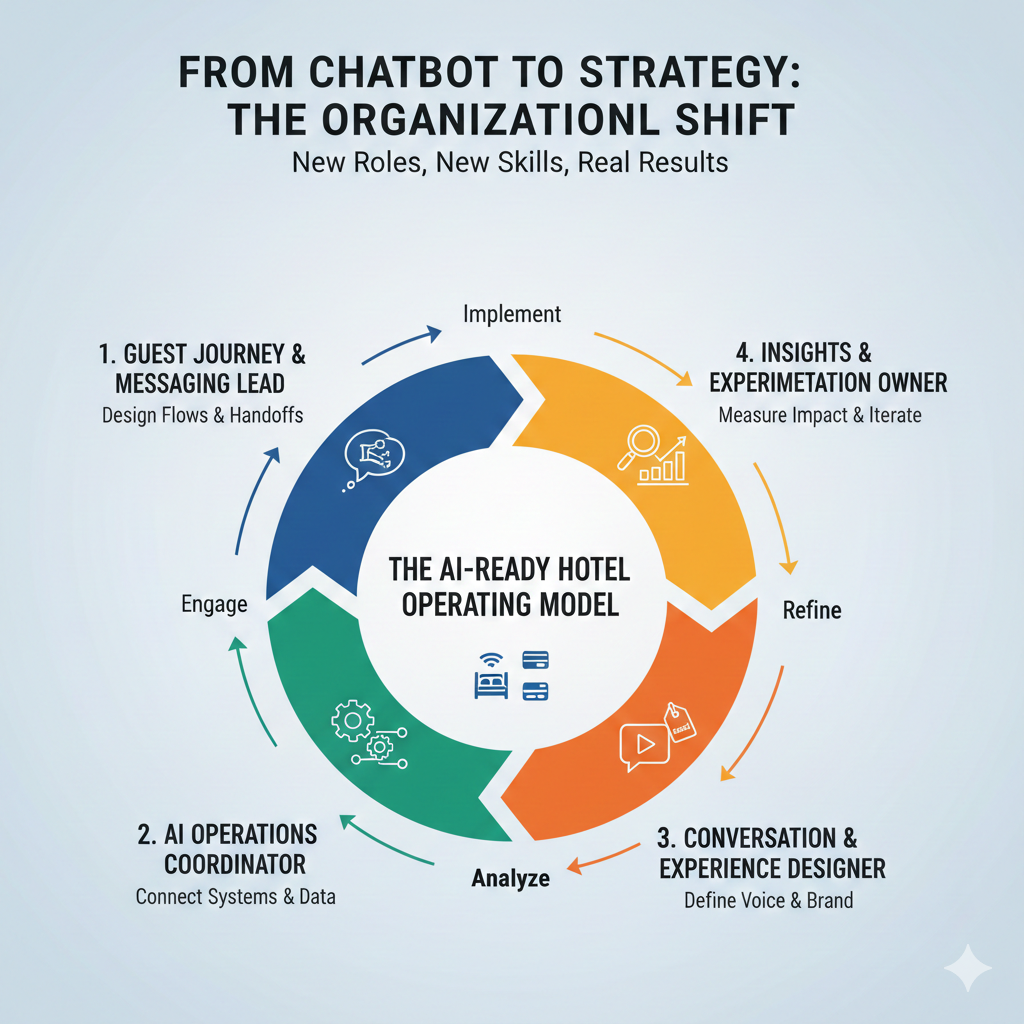
Four new roles (or “hats”) for an AI-ready hotel
In many properties, these won’t be entirely new full-time jobs at first. They’ll be hats worn by existing managers. What matters is that each hat has a name and a person, and they collaborate in a continuous loop.
1. Guest Journey & Messaging Lead
Core question:
“What does the end-to-end conversation with a guest look like across all channels, and how does it successfully hand off to a human when needed?”
This person:
- Owns the messaging and conversational experience across WhatsApp, SMS, web chat, email, and app.
- Thinks in journeys, not channels: pre-booking questions, pre-arrival, in-stay requests, service recovery, post-stay.
- Works with operations, revenue, and marketing to define which moments should be automated, assisted, or fully human.
Key success metric to add:
Escalation Success Rate – % of AI-to-human handoffs that result in a closed task and a satisfied guest.
2. AI Operations Coordinator
Core question:
“When a guest asks for something, does it actually get done, and does the system confirm the completion?”
This is the person who treats AI as part of the operational plumbing, not a shiny interface. They also serve as the critical liaison to IT and vendors to ensure tool integration.
They make sure that:
- Requests captured by AI turn into tasks in PMS, housekeeping, and maintenance systems.
- Statuses come back, so conversations can be closed with confidence (“Your late checkout is confirmed in room 514”). This requires two-way data flow.
- Automation rules (e.g., “offer late checkout if occupancy < X”) are aligned with real operational constraints.
- There’s a simple process for reporting when the AI did something wrong or created friction.
Key success metric to add:
Task Closure Rate (system-validated) – % of AI-triggered tasks marked complete by the PMS/housekeeping system.
3. Conversation & Experience Designer
Core question:
“Does this feel like our brand, or like a generic bot—and what is the AI’s emotional resonance?”
Even with very capable models, AI still needs design input. This role creates a brand style guide for AI.
This role:
- Writes and curates message templates, and provides examples of the right tone: how you say “no,” how you apologize, how you delight.
- Establishes guardrails: what not to say, when to escalate, what to double-check.
- Reviews real chat transcripts to spot awkward phrasing and improve prompts/templates.
- Works with HR/training to align AI communication with your service standards and brand personality.
Key success metrics to add:
- Sentiment Score – post-conversation guest rating or analysis of tone.
- “No-improvisation” Rate – % of conversations that follow pre-defined, tested flows rather than AI freelancing in sensitive areas.
4. Insights & Experimentation Owner
Core question:
“What did we learn this month, and what are we changing because of it?”
Instead of looking at dashboards once a quarter, this role creates a simple, regular testing rhythm and treats guest conversations and AI data as a continuous feedback loop.
They:
- Track a small set of meaningful KPIs:
- Run simple experiments:
- Bring those learnings into weekly or monthly ops meetings.
You don’t need a dozen dashboards. If you start by tracking time to resolution, system-validated task closure, and revenue per 100 conversations, you’ll already be ahead of most hotels.
Key success metrics to add:
- Lifetime Value (LTV) Lift – LTV for guests who engage with AI vs. those who don't.
- Cost-per-Conversation Reduction – how much it costs you to handle 100 conversations now vs. before.
The power of the AI-ready organization lies in this continuous feedback loop: design → execute → measure → refine.
How existing roles need to evolve
You don’t need to tear up your org chart. But some traditional roles do change shape when AI becomes part of daily life.
General Manager / Owner
Old expectation: approve a budget, expect magic.
New expectation: own an AI service strategy and champion the learning process.
That means:
- Being clear on the business outcomes you expect (e.g., “increase ancillary revenue by Y%,” “shave Z minutes off average TTR”).
- Asking better questions than “How many chats did we have?”
- Supporting time and space for the four hats above to exist and collaborate, ensuring budget is secured for learning, not just launching.
Ultimately, the GM’s role is to make sure AI projects show up in the P&L—as more revenue, fewer avoidable refunds, and more efficient use of staff time.
Front Office & Reservations
Old expectation: answer every question yourself.
New expectation: orchestrate, supervise, and humanize.
As AI handles routine questions, front office work shifts:
- From typing the same directions 20 times a day to reviewing and tweaking AI-suggested replies.
- From chasing towels and extra pillows to handling exceptions, emotions, and VIPs.
- From reacting to individual complaints to acting proactively when AI flags risk.
Staff feel less like robots and more like hosts. They must be trained on clear escalation rules and an “AI as analyst” mindset—using the patterns and insights from AI to improve operations, not just to send replies.
Marketing & CRM
Old expectation: send campaigns, manage the website, own the brand.
New expectation: co-own the conversational brand and use data to refine segmentation.
Marketing and CRM teams should:
- Provide the guidelines, phrases, and examples that define your “voice” in conversational channels.
- Work with the Conversation & Experience Designer to test messaging that not only sounds good but also converts and calms.
- Use conversational data (topics, sentiment, timing) to refine audiences and offers.
Housekeeping, Maintenance, F&B, Spa
Old expectation: receive tasks from humans.
New expectation: work comfortably with tasks triggered by AI.
The crucial element is the feedback loop:
- Tasks should look and feel exactly like any other work order in your system. Staff shouldn’t have to care whether a human or an AI created it.
- Make it easy for teams to say “this rule doesn’t work” or “this request should always be checked with us first.” That feedback goes straight back to the AI Operations Coordinator.
If you don’t invite that feedback, AI risks becoming something that keeps “promising” on behalf of teams who were never consulted.
Governance: shifting AI from a service tool to a commercial lever
As soon as AI is allowed to change reservations, grant discounts, or send compensation, you need governance. This is where the revenue strategy meets the AI implementation.
Start simple with three sets of rules.
1. Autonomy rules – the commercial guardrails
What can the AI do automatically?
- Discounts and perks: What is the AI’s room to offer a discount, upgrade, or credit?
- Inventory access: Can the AI book a specific room type or only offer generic confirmation?
- Upsell authority: Within what range can the AI propose late checkout, breakfast, or upgrades without human approval?
2. Escalation rules
What must be checked by a human?
- Any complaint above a certain sentiment/keyword threshold
- All requests involving safety or security
- Anything involving guests under 18
- High-value VIPs or complex multi-room bookings
3. Risk & brand rules
- Words/tones to avoid (especially around sensitive topics).
- Topics that are off-limits.
- Clear instructions on when to say “I’m transferring you to a colleague who can help better.”
These rules shouldn’t live only in a vendor’s configuration panel. They should be visible, understood, and revisited as you learn.
Training: turning fear into confidence
If you roll out AI and only train staff on “which button to press,” they will quietly resist, override, or ignore it. Good training focuses less on how the technology works and more on how we work together.
Practical ideas that work on the floor:
- Transcript reviews:
- “Adjust, don’t rewrite” exercises:
- Turing test–style exercise (internal):
- AI as analyst mindset:
Over time, the story shifts from “AI will replace me” to “AI filters the noise so I can focus on what I’m actually good at.”
A simple 90-day roadmap
If this all feels like a lot, here’s a realistic starting point for a single property or small group.
Days 1–30: Make it visible
- Map where AI already touches the guest journey.
- Name the four hats and assign them to real people (even if only a few hours per week).
- Agree on 3–4 core KPIs you’ll track (shifting from vanity metrics to commercial/operational outcomes).
Days 31–60: Fix the biggest leaks
- Run transcript reviews to find obvious issues (broken promises, slow resolutions, confusing answers).
- Work with the AI Operations Coordinator to close gaps between messaging and operational systems, ensuring two-way data flow.
- Put basic autonomy/escalation rules in writing and get revenue team sign-off.
Days 61–90: Start experimenting
- Test one or two concrete changes per month: a new upsell flow, a new recovery script, a tweak in escalation logic.
- Review the impact in your KPIs, and decide what to keep.
- Share wins and learnings with the whole team so it feels like their success, not “the system’s.”
Final thought
Most hotels today are underusing AI not because they picked the wrong tool, but because they kept the old org chart.
An AI-ready hotel doesn’t look futuristic on paper. It looks like a place where:
- Someone owns the guest journey across channels.
- Someone connects AI to real operational work.
- Someone cares about the voice and experience.
- Someone measures impact and drives change.
Give those responsibilities a home, and the technology you already have will start behaving much more like the partner you were promised—and much less like yet another system that nobody really owns.